Earlier JESC articles already covered the NGO funding “scandal” which has shaken Brussels for more than a year now. As the scrutiny working group on NGO funding of the European Parliament has already met for the third time, we offer you a longer take on the root of the crisis and why we see it as a worrying development for European democracy.
On November 12th 2026, the European Commission released its long-awaited “Civil Society Strategy”. The opening paragraph of the Communication is a vibrant endorsement of the role played by civil society organisations (CSOs), describing them as “contributing to policymaking, partnering with governments to implement public policies, delivering social and community support and services, raising awareness about important social issues, and representing diverse groups in vulnerable situations” (1). The text goes on to describe how critical civil society is in fostering citizens’ involvement, public debate, as well as in monitoring policies and holding political bodies accountable. Building on this extremely positive outlook, the text follows with key commitments. A promise first to engage with CSOs, involving them through dialogue “in the design, implementation, monitoring, and evaluation of EU legislation and policy.” An engagement then to defend “an enabling, safe and supportive environment throughout the EU.” And, finally, the recognition that public funding is necessary for civil society to fulfil its role.
The positive and appreciative tone of the text is worth noting. Once, it would have spelled out a fairly consensual position around Brussels policy quarters. Today, it clashes with the highly negative and critical mood about non-governmental organisations (NGOs) that has seized some European policymakers for more than a year now. Some journalists have even spoken of a “war on NGOs” (2). All three of the commitments mentioned above are actual points of tension today. It has not been clear in recent months whether civil society actors are still really welcomed in all quarters as interlocutors on topics such as ecology, migration, or social rights, at a time when deregulation is being touted as the silver-bullet solution to Europe’s lack of competitiveness. And it is not just in Brussels that many NGOs feel neither “enabled, safe, and supported.” Some European states have moved beyond criticism to actively hinder the work of NGOs on their territory, from administrative and fiscal harassment to outright criminalisation of their activities. As for funding, criticisms have turned into calls for action: let there be no more funding for critical voices.
As the European Union institutions struggle with the place and role to give to civil society, it is crucial to recognise that the debate is not about politicians wounded in their pride by NGOs’ criticisms or NGOs fighting to preserve their grants and subsidies. It is more deeply a question of political legitimacy: are elected officials the only legitimate actors in defining our society’s direction? As they allocate common resources, which criteria should guide them? Should they be seen as fully sovereign or at the service of a social fabric, equally embodied by non-state actors? Does civil society have its own form of legitimacy, complementary to the electoral process? Discerning the various roots of the criticisms emerging today and the visions that underpin them is necessary to properly assess the value of those criticisms in light of the basic principles of Catholic Social Teaching, especially subsidiarity.
As a preliminary note, the understanding of civil society organisations for this article will mirror the broad definition used by the European Commission in its strategy: all non-state, not-for-profit, independent, non-partisan and non-violent organisations, through which people pursue and defend shared objectives and ideals. They are self-governing entities which are independent from government or from business interests, ranging from informal, to semi-formal and formal groups, and can be membership-based, cause-based, or service-oriented. They can operate at the local, regional, national, and international level, and be run by volunteers and/or paid staff. In this broad acceptance, the definition includes both action-oriented and advocacy-oriented groups. References to non-governmental organisations (NGOs) will also appear regularly. While distinctions could be drawn, the terms are often used interchangeably in daily speech. In quite a few key fields (migration, ecology, …), what is commonly designated as NGOs (structured, non-profit organisations dedicated to a humanitarian cause, often transnational and supported by paid staff) is indeed routinely perceived as the visible face of civil society.
The scandal that quite wasn’t
The current conflict has been brewing for a long time. What makes it so crucial for the understanding of European democracy is the fact that it is not about corruption. It is squarely a political question. The Quatargate corruption scandal, which exploded in 2022, might have added fuel to the fire. However, the NGO then accused of serving as a vessel for corruption could hardly be seen as a legitimate expression of civil society. They were hardly more than a tool for networking and lobbying masquerading as an NGO. If anything, the case more strongly highlighted the failings of politicians than of legitimate CSOs.
The terms of the current accusations were posed as far back as 2017, in a draft report from then MEP Markus Pieper, a German member of the European Popular Party (EPP). He alleged two main problems. The first was that funding was going to NGOs not only aligned with EU values (a core requirement for any EU financial support) but also not in line with “strategic commercial and security-policy objectives of the European Union Institutions” (3). The second claim was that units of the European Commission were directing grants towards NGOs sympathetic to their policy objectives, pushing said NGOs to lobby the Parliament on their behalf. At that time, the substantive criticism levelled at NGOs was the opposition of some organisations to the free trade positions of the European Union. At stake were negotiations of a free trade agreement with Mercosur, criticised then as now by various parts of civil society for their possible negative social and ecological consequences. Attempts to turn the report into policies failed in 2017 due to push back from centre to centre-left parties. Still, there was then already overall support from right-wing parties to put NGOs under more scrutiny.
These ideas found a new breath in the buildup to the 2024 European elections. As the European Green Deal quickly became a political target for the right, accusations of collusion between environmental NGOs and the Commission came back. They focused on the operating grants received by 28 NGOs under the “LIFE” programme, a programme of the EU dedicated to promoting projects in the field of environment and climate action. Created as far back as 1992, LIFE was reinforced in view of supporting the Green Deal for the period 2021-2027, with a budget of €5.4 billion. But, despite sensationalist news headlines, only a fraction of that budget was under fire. Most of the funds are allocated to projects with clearly defined objectives and actions. Furthermore, the recipients were varied: public as well as private, for-profit as well as non-profit. Truly at stake were grants designed to help NGOs to cover their operating costs, for a maximum of €700,000 per organisation. In total, this represented about €15.6 million, less than 0.3% of the LIFE programme envelope. These were hastily decried as funds available for lobbying, brushing over the other very real costs they were intended to cover, such as organising events, leading public campaigns, or publishing reports.
This outcry still led the Commission to issue new guidelines in May 2024 on the kind of activities that could figure in funding agreements between the Commission and grant recipients, specifically banning direct forms of advocacy – even if those were not in themselves illegal – and making clear that any policy views expressed by grant recipients were their own and were not endorsed by the Commission (4). These guidelines were then enforced on “Green” NGOs in November 2024 (5). The new rules were based on the idea that the European institutions could suffer reputational damage if NGOs were seen lobbying other institutions, not on the basis of any illegality.
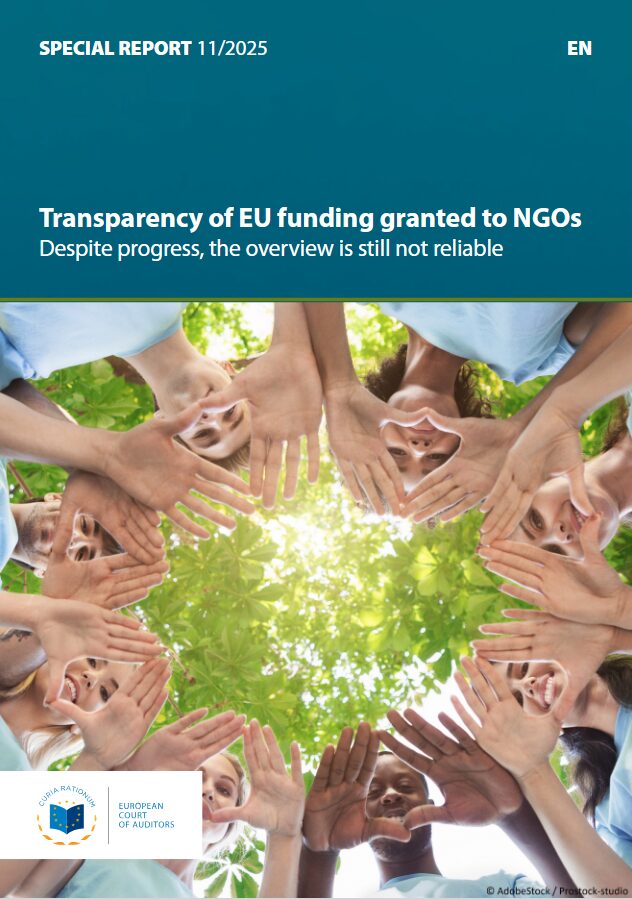
Accusations grew stronger in early 2025. They were boosted first by a report from the European Court of Auditors on the transparency of EU funding granted to NGOs, published in March 2025 (6). The report did not, in fact, identify any major wrongdoing on the NGOs’ side. It, however, pointed out inadequacies in the way the Commission was assessing and monitoring NGOs’ funding and a lack of openness around the content of work plans agreed between NGOs and the Commission. While NGOs felt vindicated, critics seized the report as proof that deep, radical reform of NGOs’ funding was necessary.
Shortly after, the Commission cautiously admitted that “in some cases work programmes submitted by the NGOs and annexed to the operating grant agreements contained specific advocacy actions and undue lobbying activities” (7). While NGOs’ critics on the right considered they were holding their smoking gun, many observers were quick to point out that the Commission’s statement was not in any way a validation of the conservative narrative (8). Work programmes are drafted by the NGOs, not dictated by the Commission. Those “specific advocacy actions” were not mandated by the terms of grant applications, nor were they the result of the Commission amending NGOs’ proposals. The NGO’s own objectives are more than enough to explain their existence, without the need for a conspiracy orchestrated by the Commission. Short of giving marching orders, could the Commission have cherry-picked organisations most aligned with its own goals? This is just as dubious, considering how grants went to established organisations with a long track record of not simply acquiescing to Commission policies but also of criticising those.
In the end, what came up felt very much short of a grand, shadowy plot. Nevertheless, in June 2025, the EPP breached its usual alliance with the other centrist parties to establish a working group in the European Parliament to scrutinize NGOs’ funding, with the support of the European Conservatives and Reformists (ECR) and the Patriots for Europe (PfE) groups. In the words of Oliver Röpke, President of the European Economic and Social Committee, “this decision comes despite repeated confirmation from both the European Commission and the European Court of Auditors that EU funding to NGOs is transparent, lawful, and aligned with EU policy objectives. At the same time, scrutiny must be applied in a fair, balanced and comprehensive way. Singling out civil society organisations risks distorting the public debate and undermining a sector that is essential to democratic life in Europe” (9).
This scrutiny working group has met three times already. It has turned into a highly partisan affair, as left-wing and centrist parties have decided to boycott it from day one. All three seances have seen the same political theatres: puzzled Commission officials grilled by centre-right MEPs while the radical and far-right groups extoll the virtue of Hungary crackdown on civil society. The fiery tone of a scandal has however slightly died down, with a leading MEP forced to admit that “The problem that we’re pursuing here is not to establish whether things are illegal, it is to establish whether politically it is undesirable” (10). Even so, MEP on the scrutiny working group have expressed their desire to expand their investigations into NGOs active in the fields of migration and human rights.
But still had some real consequences
 Even if coming from a fringe segment of the EU Parliament, the controversy could not have come to a worse moment. Proposals from the Commission for the next Multiannual Financial Framework (MFF) see the LIFE programme merged into two different EU instruments, the new European Competitiveness Fund (for its more industrial policy-oriented aspects), and the EU Facility (11). The latter is a catch-all fund designed to address cross-border issues, not only in the environmental field but also in the fields of social rights and migration, among others. LIFE projects would lose their dedicated budget, putting them in competition with other priorities of those two instruments. Crucially, nothing is said about operating grants under the new regime. Despite reassurances from the Commissioners in charge that all the elements of the LIFE programme will be ported to those new instruments and will find a better, more flexible residence there, this reorganisation is still a clear downgrading of environmental and climate action in the Commission’s vision.
The effects of that debate have not been confined to the field of ecology. CSOs active in the field of health had to wait the whole first semester of 2025 before seeing calls for projects published by the Commission, under the EU4Health programme. Left in the dark, 30 organisations that collaborated for years with the Commission thus only discovered in July 2025 that operating grants on which they relied would not be forthcoming (12). This was done without justification or consultation between the Commission and the organisations with which it had signed partnership agreements.
The relationship between EU institutions and civil society should also not be seen exclusively from the perspective of the campaign in the Parliament. There is still ample and fruitful collaboration between various departments of the Commission and CSOs; the Strategy quoted at the introduction of this article is not just empty words and wishful thinking. It is also striking how there is a real unease among Parliament and Commission staff about the topic; the belligerent approach does not sit well after years of attempts to make the institutions more receptive to civil society. Some might have seen the collaboration as a remedy to bridge the European democratic deficit; some might have seen as an extension of traditional politics in most Western European countries.
However, on some essential topics, the temptation to bypass real, honest dialogue has been on full display. It has been exemplified by the first “omnibus” simplification package, a text watering down the requirements of the Corporate Sustainability Due Diligence Directive – which requires large companies to identify and correct human rights and environmental violations in their operation and supply chain – and the Corporate Sustainability Reporting Directive – which requires large companies to report on their environmental impact. The Commission, under pressure from national governments and from the EPP in the Parliament, argued that this “simplification” was necessary to make European companies more competitive by reducing administrative burden. In the name of urgency, public consultations were simplified to the extreme, mostly reduced to closed-door meetings where business interests were overwhelmingly represented compared to trade unions and NGOs (13).
There is still one area of EU policies where the Commission proposes to increase funding for civil society: the Citizens, Equality, Rights and Values Programme (CERV). The programme funds initiatives to fight discrimination and support EU values, democracy, and citizens’ engagement. The proposed growth should be significant, from €1.55 billion in the previous MFF to €3.6 billion in the upcoming one. While this is, at first glance, a positive development, there are reasons to be cautious. There is no guarantee that this increased funding will be supported by EU Member States and the Parliament. In a context of difficult budgets, of massive reductions in aid and development budgets, and of NGOs’ criticisms, nothing is less certain. Furthermore, this growth can be seen from the point of an unwelcome shift: from a situation where civil society is a partner on essential, substantive policies to a participation reduced to more formal aspects of democracy. Civil society would be seen not as a partner of political entities but just as an enabler of democratic electoral politics.
The Green Deal rollback
If the accusations of covert lobbying do not seem to hold much to scrutiny, this brings us back to the other original argument: CSOs must be held under greater scrutiny, to make sure they act fully in line with the “strategic commercial and security-policy objectives of the European Union Institutions.” The ones not fully aligned must be defunded. The attempt to create a scandal around the lobbying issues then appears as nothing more than a way to get more favourable optics in the court of public opinion. It is certainly easier to justify acting to correct immoral behaviour than being perceived as bluntly asserting political power.
A first reading of the situation could simply be based on raw power and naked political fight. In a changing geopolitical context, some have judged that new sets of priorities just leave no place for the “niceties” of constraining environmental policies and thus for the organisations that supported those constraints and might now hinder efficient policies. It is not a caricature that say that many policymakers now think that restoring European competitiveness and growth – and thus its economic prosperity – is the key to address all the challenges facing the European Union:
- It would allow to fund European defence and security needs, guaranteeing peace;
- It would allow to sustain Europe’s welfare systems, preserving social peace;
- It would allow Europe to stand up to its geopolitical pairs, ensuring long-term relevance;
- It would even allow to limit greenhouse gasses emissions through a technology-oriented energy transition, limiting the impact of climate change.
From that cold perspective, betting all on economic growth and technological progress, businesses are the most natural partners of the political world. Their opinion is the one to be valued, their needs the ones to be accommodated. Such an approach will require rolling back environmental, privacy-oriented, and social regulations but so be it! Such is the price for survival.
That such a rollback is underway is obvious. It is fully assumed by the von der Leyen Commission, which is issuing so-called “simplification” omnibus in many fields (14). The extent of the rollback is, however, an ongoing political debate. To many of the progressive policymakers and to wide segments of civil society, the Commission’s proposals have generally appeared excessive: too business-friendly, undoing years of progress. To many national capitals and to the centre-right, they do not go far enough. For Eurosceptic parties, those regulations were anathema from the start.
The bitterness of this fight is hard to overstate. On November 13th, the first omnibus package, mentioned above, was approved in the European Parliament. The version that passed had been amended by the EPP, going further in deregulation than the Commission’s proposal, and was voted through by the combined votes of the centre-right and the votes of the radical and far-right parties. A first, softer version negotiated by the centrist parties had failed to pass earlier as some socialist MEPs considered it too aligned with the EPP’s positions. Negotiations between the EPP (Christian democrats and Conservatives), S&D (socialists), and Renew (liberals) had reportedly been heavy-handed, with the EPP hanging over the discussion the possibility of a tactical alliance with the Eurosceptic right-wing parties (no such alternative exists on the left without the EPP). Rather than resuming negotiations, the EPP made good on its threat, tearing down the “cordon sanitaire,” the longstanding gentlemen’s agreement between centrist parties not to pass legislation by allying with the far right.
It was objectively a seismic event in European politics. And it confirms the fear of many CSOs: if the EPP is willing to go to that length to impose its own agenda over the partners it objectively needs (as Eurosceptic parties still are not reliable allies for the EPP on many other topics), a fortiori, why would it have more restraint in disregarding the interests of actors it does not feel it needs?
Populism changing the rules of the game
Another major shift is at work beside the move to an economy-first focus. It is the rise of the populist and far-right parties all over Europe. Very practically, it created a parliament in Brussels where right-leaning policies once difficult to imagine are now possible. This change was illustrated by the vote establishing the working group on NGOs’ funding or the sustainability omnibus vote. But its main effect might be more insidious.
The rise of parties characterized by anti-establishment positions is petrifying mainstream parties. In the most direct fashion, they erode their electorate and their position. In parliamentary politics, extreme parties force centrist groups to work together if they do not want to collaborate with the former. This slowly robs traditional parties of the possibility to profile themselves as meaningfully different from one another, reinforcing the populist narrative of the old parties being part of an alleged “system,” unable to offer real alternatives. The mainstream parties find themselves forced to either denounce populists in a never-ending crescendo, to the point of excess, or to emulate them, hoping to steal their electorate by adopting a toned-down version of their discourse.
This impacts the relationship between parties and civil society. Politicians are well aware, maybe excessively so, of the evolution of many European countries. Many parties used to be linked to a faith-based, ideological, communitarian, and/or regionalist ecosystem of organisations. Individualism and a declining sense of belonging to intertwined communities have dulled political and social loyalties. Parties that long had embodied political representation for wide segments of society, such as Christian-democratic or socialist parties, had to learn to cope with “unfaithful” voters. It brought them to downgrade their historical links with weakened intermediary bodies -especially trade unions- and to marginalise bottom-up militantism in favour of top-down political marketing/communication.
Populist parties reinforced that trend. They themselves were often born outside those organic networks of intermediary bodies. They naturally practice a simple, direct messaging aimed at citizens who feel isolated, out of structured networks. In this horizontal vision, they offer the dream of a new community, fully enclosed in the movement they embody. If they refer themselves to some form of intermediary bodies, it is often to a nostalgic ideal of it, as it once was, not as it stands today. Too often, the Church is instrumentalized in this fashion. Worse, actual associations, movements, and organisations in their current incarnation are then vilified as part of the “system.” The subsidies they receive, their historical links with administrations and political entities, and the alignment of their policy objectives with mainstream parties are seen as proof of an unholy entanglement, not as the results of a longstanding cooperation for the common good.
If anything is a matter of political marketing, truth also becomes secondary. The priority is to build a like-minded political community. Caricature and lack of nuance become the norm. Any position that does not align with the view of the party can be dismissed. In recent days, any call for social or environmental justice can find itself branded as sentimental “wokism.”
This adds an extra layer of pressure on mainstream political groups, especially for those on the right. They now have to fend off accusations of being too close to organisations criticized by populists. The temptation is great to echo part of their rhetoric to deflect such criticisms.
This leads us a step further, towards calls to defund NGOs that “overstep” into political debates. From the ideals of neutrality, non-partisanship, and independence, which truly underpin CSOs, some political parties argue that civil society should refrain from entering political debates, especially if they receive any advantage from the state. Considering how policies all over Europe are hardening when it comes to migration, environmental issues, or social rights, and how critical many CSOs have been of this change, it is a small step for conservative politicians to see them as adversaries. This dynamic has been particularly on display in recent years in Germany and more precisely in Bavaria. The local centre-right party, the CSU, has called to cancel tax-exempt status for NGOs that participate in protests against state policies they established. Some see the campaign at the European level as nothing more than an extension of those attacks (15). Leading members of EPP are indeed members of the CSU.
For some, defunding is not the endgame yet. Effectively banning critical CSOs and subjugating civil society to their political ideology is. In a recent column (16), Prof. Alberto Alemanno eloquently exposed the strategy already at work in some corners of the European Union: delegitimise through exaggerated scandals, institutionalise the criticism, defund, and criminalise. Criminalisation can come in different guises. It can manifest itself in making illegal the services rendered by NGOs, as Hungary did for organisations serving migrants (17). When civil society receives support from foreign donors, this too can be then weaponized, on the model of Russia’s infamous law branding NGOs as “foreign agents.” Such can be seen in Slovakia (18) or Hungary (19). Alternatively, administrative, anti-fraud, or fiscal tools can be unfairly mobilized. The line between “illiberal democracy” and more traditional conservative parties still (mostly) passes today between defunding and criminalizing.
A vital relationship
Needless to say, the very idea of suppressing CSOs should be abhorrent to anyone attached to a democracy truly rooted in dialogue but also in view of Catholic Social Teaching. Society is not a blank canvas at the disposal of the state, even in a functioning democracy. Nor is it a battlefield where political groups attempt to dominate. Society is, on the contrary, the place where persons express their abilities, not just as individuals, but as members of communities. The person is never alone facing the state but unmeshed in a network of associations, which, to be meaningful, cannot just be ready-made options offered “from above,” as mandatory youth movements or pseudo-trade unions were in Communist or Fascist regimes. Civil society, to be genuine, must be the organic extension of the creative force of men and women, able to form fraternal partnerships to tackle their needs and concerns.
Respect for this natural order is the true meaning of subsidiarity. Subsidiarity does not just apply inside the political realm, throughout the chain of political power entities, preventing higher entities from grabbing power from smaller ones. Subsidiarity also dictates the relationship between the realm of political power and the realm of intermediary bodies: formal political power serves society, not vice versa. The state is there to create an environment fostering the healthy development of associations (and businesses, for that matter). It should also provide a framework of rules and regulations to preserve the peace and common values of the greater society. It should not, however, aim to always replace them with its own institutions, unless strictly necessary in view of the common good.
This is why it is legitimate for the state to provide funding and subsidies for CSOs. It is not simply a matter of getting some services done for cheaper than would be done by developing a state administration or by contracting a for-profit company. It is about letting people take care collectively of what they value. It is the role of the state, though, to provide this support according to the available resources and according to the priorities set by elected bodies. This must be done fairly, in a non-partisan manner, and on an objective basis.
The system of calls for grants fundamentally serves that purpose of allocation for the European Union. The Commission makes public what the EU needs and how much money is available for each need. Various actors propose themselves and are selected on their merits to fill the need. This should not be seen – least of all by lawmakers – as simply buying a service from a provider, as you would from an accounting or engineering firm. It is a partnership, even if it can be, in practice, a very unbalanced one. There is also no question that the whole process of allocation can be criticized and might merit reforms. Not so much because it would be open to political rigging by the Commission but rather because, in a search for “objectivity,” much of it has been delegated to external experts in a fashion that can be quite opaque and lacks accountability.
Going a step further, is it legitimate for the State (or, in our case, the European Union) to offer money to CSOs for activities which are not directly in line with its policies or even critical of these? Up to advocacy and lobbying? We would argue that yes, it is, insofar as the CSOs chosen for such support are bringing expertise and balance to the public debate.
Expertise is not limited to technical competence. CSOs can bring to the table another outlook, informed by a proximity and familiarity with the people they serve that no administration nor consultant can match. Bringing that human experience is vital for the design of fair and just policies at the political level. Such grassroots experience also makes possible control, monitoring, and accountability. When policies go wrong, when standards unduly relax, activists play a crucial role in helping our societies uphold their values.
Balance is also sorely needed. The money spent on advocacy by NGOs is just a small fraction of what is spent by businesses. Lobbyists self-reported €343 million in spending for 2024, a figure well under the likely real total (20). There is a strong societal interest in having policy debates that are not one-sided, that make lawmakers consider all reasonable options with seriousness before making a decision. That requires giving different voices a fighting chance. Too often, it means giving a voice to those who cannot speak loudly enough.
This imbalance also illustrates where the real risk is in terms of lobbying practices in Brussels. Yes, lobbying and advocacy reaching out to MEPs should be transparent to avoid corruption. It should be limited to the provision of ideas and the building of above-board alliances. But scrutiny should apply to all, fairly. In fairness, it is hard to conclude that NGOs are a greater risk than businesses/lobbyists: the latter have potentially far more enticing tools and options to bring MEPs to their point of view than CSOs.
Conclusion
It is certainly disheartening to see that many attacks on civil society today in Brussels are coming from parties with Christian-Democrat roots. It is even more disheartening to realise that they are willing to join forces with populist forces on the topic and to adopt their narrative, enabling ever more outrageous attacks and eroding the very foundations of our democracy.
When it comes to NGOs’ funding by the EU, not all questions should be dismissed out of hand. Much could be discussed and not all grievances are unreasonable. Have CSOs become too dependent on public funding? Are they diverse enough, representative enough?
It is hard to imagine this discussion taking place or going anywhere without trust, mutual respect, and appreciation for the other’s role. Will Europe find the strength to reject the sirens of political expediency or continue to sink into polarization?
Benoit Willemaers SJ
JESC Secretary for European Affairs
________________________________________
- Communication from the Commission to the European Parliament, the Council, the European Economic and Social Committee and the Committee of the Regions: EU Strategy for Civil Society, Brussels, 12/11/2025
- See, for example: www.politico.eu/article/european-peoples-party-epp-ngo-funding-civil-society-far-right
- Draft report on budgetary control of financing NGOs from the EU budget (2015/2345(INI)), point 6
- Guidance on funding for activities related to the development, implementation, monitoring and enforcement of Union legislation and policy, Ref. Ares(2024)3320196- 07/05/2024
- https://www.politico.eu/article/european-commission-ngos-lobbying-environmental-advocacy-green-funds-life-program/
- https://www.eca.europa.eu/en/publications?ref=SR-2025-11
- https://ec.europa.eu/commission/presscorner/detail/en/statement_25_942
- https://www.politico.eu/article/fact-check-european-commission-ngo-lobby-green-deal-activist/
- https://www.eesc.europa.eu/en/news-media/presentations/statement-establishment-european-parliaments-scrutiny-working-group-ngo-funding
- https://euobserver.com/203164/why-rightwing-inquiry-into-europes-ngos-was-never-about-transparency
- https://www.birdlife.org/news/2025/09/30/the-future-of-life-whats-at-stake-in-the-next-eu-budget/
- https://eu4health.eu/content/uploads/2025/09/eu4health-csa-letter-to-commission-formal-complaint.pdf
- https://www.etuc.org/en/pressrelease/corporate-lobbyists-dominate-rigged-simplification-roundtable-corporate-sustainability
- https://commission.europa.eu/law/law-making-process/better-regulation/simplification-and-implementation/simplification_en
- https://www.friendsofeurope.org/insights/critical-thinking-backsliding-democracy-navigating-political-pressure-on-civil-society-in-the-eu/
- https://euobserver.com/eu-political/ar1c67c9a3
- https://ec.europa.eu/commission/presscorner/detail/en/ip_19_4260
- https://slovakmonitor.com/slovakia-passes-ngo-law-echoing-russia-targeting-its-own-civil-society/
- https://euobserver.com/rule-of-law/ar96012839
- https://corporateeurope.org/sites/default/files/2025-02/EU%20Lobby%20League%20briefing%2024.2.2025.pdf