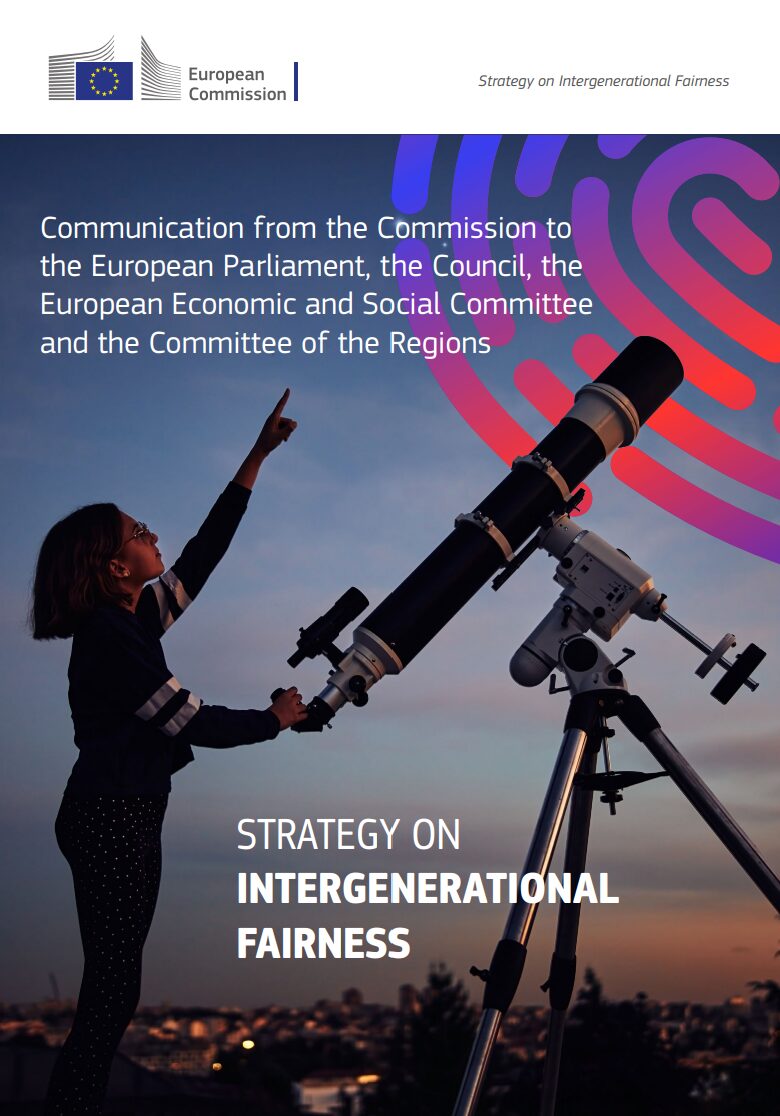
The European Commission has just published its first-ever Strategy on Intergenerational Fairness. This is a moment we have worked towards for years. The Future Generations Initiative — a coalition of civil society organisations jointly coordinated by JESC and The Good Lobby — campaigned for the establishment of a Commissioner responsible for Future Generations, contributed to the consultation process, submitted detailed policy proposals, and engaged directly with Commissioner Micallef’s cabinet throughout the strategy’s development. The publication of this strategy is a milestone. It is also the beginning of the harder work ahead.
The Strategy asks the right questions
Firstly, the new brand Strategy places intergenerational fairness on the EU’s political agenda as a cross-cutting concern rather than a niche policy area. The Commission acknowledges that today’s decisions on climate, public finance, housing, digital transformation, and demographic change create long-term consequences for people who cannot yet speak for themselves. This framing — connecting the present to the future, across all policy domains — is new for an EU Commission Communication and reflects the approach we have long advocated for.
Secondly, it reinforces the role of strategic foresight in policymaking. It commits to a multilingual Future-Oriented Policymaking package to build anticipatory governance capacity across Member State administrations, and it announces the development of an Intergenerational Fairness Index. If this index is designed with scientific rigour — grounded in planetary science, fiscal sustainability projections, and wealth distribution metrics — it could become a meaningful tool for accountability.
Thirdly, the Strategy gives serious attention to the territorial dimension of intergenerational fairness. Where you live shapes the opportunities available to you and your children. Rural, remote, and economically disadvantaged areas face compounding inequalities that deepen across generations. The “Voices of the Future” initiative, developed in partnership with the Committee of the Regions, could bring the local specificity that EU-level strategies often lack.
Fourthly, it references the European Semester as a vehicle for embedding intergenerational thinking in economic policy coordination. If this reference translates into dedicated sections in Country Reports, intergenerational fairness indicators in the Social Scoreboard, and Country-Specific Recommendations that account for long-term impacts, it could become one of the Strategy’s most consequential elements.
Finally, the Strategy commits to a progress report in early 2028 and reiterates the EU’s engagement with the UN Summit of the Future process and the Declaration on Future Generations. These create formal moments of accountability, even if much depends on how seriously they are used.
Fairness yes, but not rights
The Strategy presents a thorough and honest diagnosis of the challenges facing present and future generations. It describes the costs of climate inaction, the erosion of social mobility, the widening gaps in housing and wealth, and the risks to democratic trust. Yet the proposed actions remain largely in the domain of coordination, dialogue, and exchange of best practices. While these tools are welcome, they do not yet match the scale of the challenges the Strategy itself identifies.
Most importantly, there is no definition of intergenerational fairness. The Strategy uses the term throughout but never defines it. Without a shared legal and conceptual definition, “intergenerational fairness” remains open to interpretation — and difficult to implement, monitor, or enforce. The Maastricht Principles on the Human Rights of Future Generations, the European Court of Human Rights’ landmark KlimaSeniorinnen judgment, and the German Constitutional Court’s Neubauer ruling all offer formulations grounded in law. The Future Generations Initiative developed a specific proposal for the legal definition of intergenerational fairness as a horizontal principle of EU law, drawing on these sources. The Commission chose not to adopt any of them.
No rights-based language. Future generations are nowhere mentioned as rights-holders in this document. This is a significant retreat from what the legal foundations of the EU would support. The EU Charter of Fundamental Rights acknowledges that the rights it guarantees entail duties toward future generations. Article 3(3) of the Treaty on European Union enshrines solidarity between generations as a fundamental objective. These are not aspirational references — they are binding legal commitments that should have been at the heart of this Strategy.
A question of coherence. The Strategy praises existing EU environmental, climate, and social policies as instruments of intergenerational fairness. Yet it was published at a time when the Commission’s Omnibus simplification packages are rolling back sustainability reporting obligations and environmental safeguards — measures which were designed precisely to ensure long-term accountability. At the Strategy’s launch, Commissioner Micallef was asked directly about this tension. Intergenerational fairness cannot be pursued through a strategy document while the instruments that deliver it are weakened elsewhere. The credibility of this agenda depends on the Commission demonstrating coherence between its words and its actions across the full range of its legislative activity.
A door has been opened
The Better Regulation Framework revision, expected in two months, is the most consequential near-term test. If intergenerational fairness impact assessment is embedded in the revised Guidelines, every major piece of EU legislation will be evaluated for its long-term consequences. If the revision instead weakens impact assessments in the name of speed and simplification, then the promise of the Strategy will be undermined before it can be fulfilled.
The Intergenerational Fairness Index must be designed through a transparent, science-based process. It should go beyond existing Eurostat composites and integrate metrics on environmental quality, fiscal sustainability, intergenerational wealth transfers, and access to housing and education by age cohort. The index’s credibility will depend on its independence and its methodological rigour.
Institutional anchoring is essential to ensure that intergenerational fairness outlasts a single Commissioner’s mandate. The Future Generations Initiative will continue to advocate for a dedicated Council Working Party, the integration of IGF indicators into the European Semester, and the establishment of national liaison offices that connect EU-level principles with implementation on the ground.
The EU has opened a door. Our task is to ensure it walks through it.
Béla Kuslits
JESC’s Senior Ecology Officer
The Future Generations Initiative is a coalition of European civil society organisations jointly coordinated by the Jesuit European Social Centre and The Good Lobby. For more information, visit fitforfuturegenerations.eu