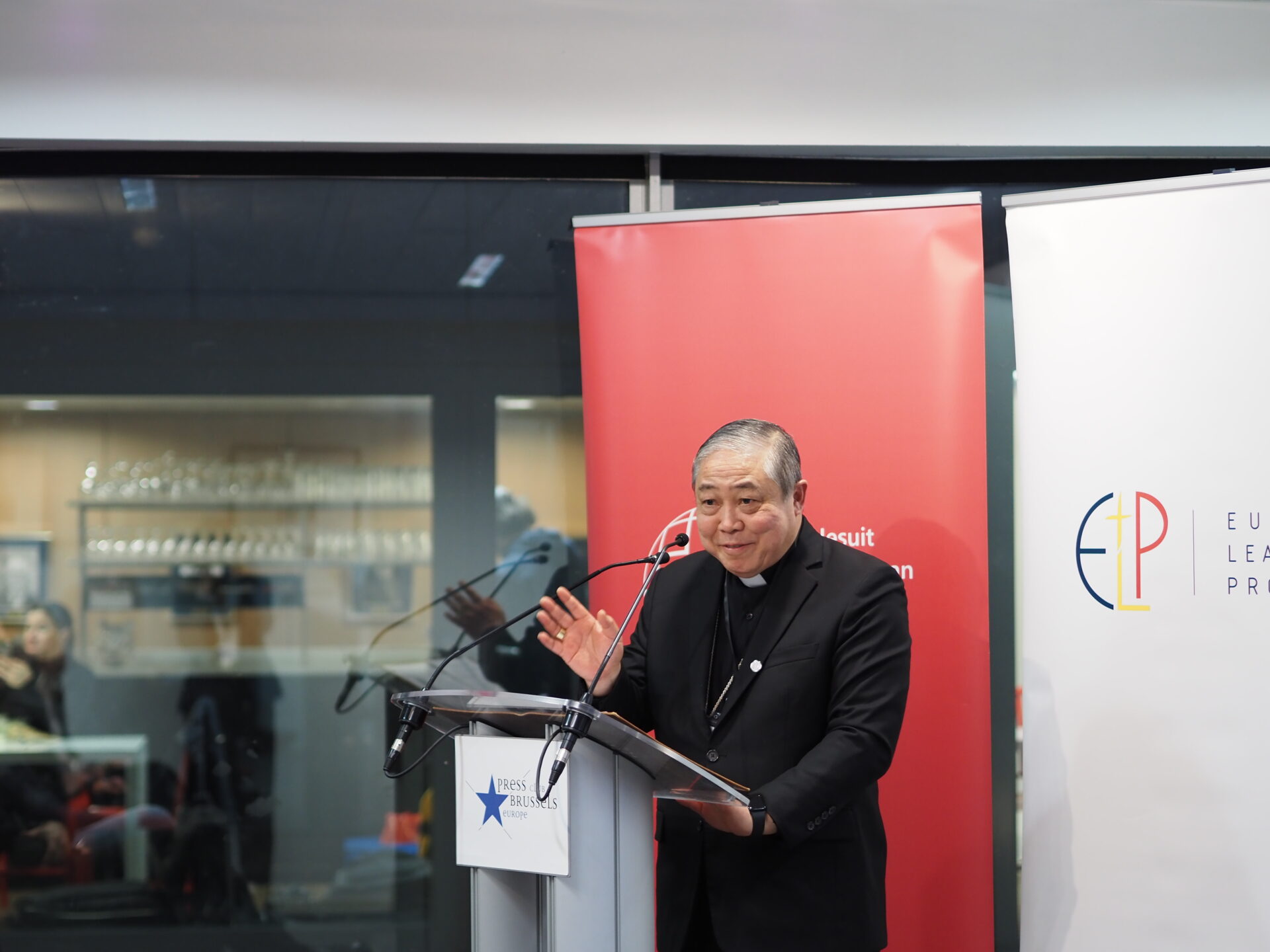
Dear Father Felipe, dear friends,
Father Felipe told me that the Fellows of the European Leadership Program live in a shared community. I hope he is not converting them to become Jesuits and nuns!
But don’t worry. I myself lived in big communities as a high school and university student from 1973 to 1990, in communities between 50 to 250 people, people of all kinds of characters, saints and clowns, from the funniest to the most boring, from the most generous to the most miserly, from the most brilliant to, well, less brilliant! But I must say the great majority were very normal people, mostly good, bright and generous, just like the graduating Fellows today!
I have so much happy memories of those years and I parted with so many friends who, until now and for life, remain constantly in contact. I wake up every morning with lots of Good mornings on my WhatsApp or Messenger from my classmates across decades. Everyone is always excited with the faintest mention of a class reunion! All my high school classmates are so excited for our 2027 reunion to celebrate our 50th anniversary of high school graduation! Those who have not become priests like me are already grandfathers and happily retired… something that I am longing for… I can read your mind, so I must clarify that I am not longing to be a grandfather, but to be happily retired!
I know retirement is something that is farthest in the minds of our young Fellows. When I think of retirement, our Fellows think of job. And to be ready for that, here at the ELP they have received important additional baggage: leadership training, a heightened sense of social responsibility, public service and solidarity, a formation toward stronger values and a more profound spiritual sense, a deeper understanding of oneself and of others.
You have all your life still in front of you, and time is on your side to educate yourselves even more, perhaps not anymore in classroom settings, but in real life in the real world. If you are going to work for the European External Action Service, you have to learn to survive stuck in the mud during rainy nights in the forests of Madagascar, like I had to. You may have to deal with social chaos and conflicts, just I had to in Madagascar, Albania or in Haiti. You may be sent to countries in rapid epoch-making transformations, as I experienced in post-communist Bulgaria, Albania and the whole of the Balkans.
If you would be assigned in Rome, where I lived for 12 years, I would like to warn you that it’s not all intoxicating art and delicious pizza. There you would have to deal with the Italians! Where are Eva Maria and Sofia? Those who know them will be sure to know that I am not telling the truth! In fact, consummate art, exquisite cuisine, the joy of living, and the Italians are… very compatible!
And even if you are sent to the United Nations in New York, where I was assigned twice lasting seven years and a half, know that it’s not all Broadway and dizzying skyscrapers, but also homelessness and bomb cyclones… and lots of work whose usefulness you wouldn’t have the pleasure of seeing.
Madrid? There so many Spaniards among the Fellows that I could never make a choice of the most beautiful places in Spain without offending one or two. I lived in Spain for five years and a half before I came to Brussels and have travelled there extensively during the last four decades.
If I say there is no place like Sevilla, Antonio will treat me to a bullfight in the Maestranza after paying homage to the Macarena and the Triana. If I say there’s no better Plaza in the world than Cibeles, Alba and Esther will add: We also have the Prado, the biggest Royal Palace still in use and… Real Madrid! Well, give me a pass to a Real Madrid – Barcelona game and I will agree with you!
But I don’t know where Elena comes from. Perhaps from Barcelona? No, Elena says she is also a very proud Madrileña, and she is telling me that I should also mention the Retiro Park and the Puerta de Alcalá. I would also add my beloved Paseo de los Recoletos. And José, Pepe: I guess he is from Extremadura, besides being almost a pure-bloodied Jesuit, right? Yes, Pepe just confirmed that he is from the region of great jamón ibérico! Y viva la Virgen de Guadalupe!
I also noted that there are many Hungarians among the Fellows and there is no Austrian. So, I can confess without the risk of being mobbed that Budapest is more beautiful than Vienna! Let’s keep that between us!
If you work in the EU institutions, you will continue to live in Brussels, a city whose vices are clear to see but whose virtues I still have to discover! Joke only; otherwise, Rudolphe would ask for my expulsion! I wouldn’t mind, as long as he expels me to the Monastery with the best brewery, or exile me to Marrakesh of Adam, or to Greenland to decide to which I country I want to belong! I’m sure Madsen, who is both American and Danish, can help me in this!
Okey, you would like to be sent to the Philippines, where I come from. There, I’m afraid you will hate Manila, because the Capital Region is an urban jungle of more than 15 million inhabitants, and perhaps up to 30 million including the neighboring cities and towns. You will surely opt for the beaches and the scuba diving in any of those more than 7,600 islands stretched vertically like pearls in Western Pacific almost 2,000 kilometers long. In one of those, some 650 kilometers south of from Manila, in the island called Bohol, I was born and raised right at a delta of confluent rivers where fresh waters meet the sea. You may think it was Paradise. Well, if you consider Paradise a place where there were more pythons and iguanas than people. It was a constant fight between those beasts and us, twelve siblings, for the free-range chickens and wild doves, which either ended up on our plates or in their bellies!
And the ubiquitous mosquitoes and the chorus of frogs on rainy nights. But there was also the pleasure of fishing red crabs and pink shrimps in the brackish waters of the river right along our backyard. As highly educated Fellows, you would know why crabs are reddish and shrimps are pinkish in blackish waters. When my brother saw a red crab for the first time crawling along the river, he exclaimed to our father, “Dad, it’s already cooked!”
But wait: how can we forget the unrefusable destination that is Gloria’s and Father Felipe’s Portugal? Unable to talk bad against our host Father Felipe, I would only like to assure him that my siblings and I love Portugal, not only because of Fatima and the Mosteiro dos Jerónimos, but also for the Porto wineries along the Douro. And I’m sure that just the mention of San António do Lisboa, and not of Padua, would be enough to put Father Felipe head over heels!
But let’s stop dreaming of future destinations for awhile and come back to the reality of Europe, of the European Union in particular.
You are here because you believe in Europe and the project of the European Union. But honestly, how has that enthusiastic belief evolved lately, in the context of a sense of crisis and urgency?
I am relatively a Johnny-come-lately-old-man-in-town, so I spent the last months meeting many EU authorities, Ambassadors and other people. Hundreds of them. The meetings almost always left with a sensation, indeed with an understanding, that Europe is going through a period of deep crisis and must recover itself with urgency. EU and foreign political discourse about Europe consolidate this impression, or this reality, with a tone bordering on panic.
Somebody from across the Atlantic tells you that the European civilization as we knew it is on its death throes, and that from now on you have to pay for your own security and pay hefty tariffs. Somebody from the far Pacific makes you realize that your electric cars and batteries are commercially uncompetitive even before they are manufactured. A huge unfriendly neighbor is at your backyard, indeed already inside your house, breaking your prized crystals and ignoring every house rule. Giant developing but economically pulsating countries ignore your New Green Deal, appealing to their inalienable right to development like what you enjoyed during the Great Industrial Revolution or the postwar reconstruction’s heavy industries, promising you that a Green Deal will arrive once they are fully developed like you. And multilateralism seems to have taken a break or entered a blind alley, as you haven’t heard lately of the United Nations or other multilateral entities, in spite of huge international peace and security crises.
And your high authorities have finally realized that things are getting very serious, that you have to up the ante. Obviously, resignation, much less surrender, is not an option. So, starkly appraising the State of the Union in stormy conditions in an unforgiving world, a new Wuthering Heights or a New York City hit by a bomb cyclone, your authorities have to rally the troops to fight, because the Europeans are feeling the ground shifting beneath them. They can feel things getting harder just as they are working harder. They can feel the impact of the global crisis. Of the higher cost of living. They feel the speed of change affecting their lives and careers…, perhaps including those of the ELP Fellows.
So, what must the Europeans do? The marching order is Europe must fight… fight for its place in a world in which many major powers are either ambivalent or openly hostile to Europe. A world of imperial ambitions and imperial wars. A world in which dependencies are ruthlessly weaponised. And it is for all of these reasons that a new Europe must emerge.
These are not my words. These are words of President von der Leyen in her State of the Union Address in September, a Speech that echoed Churchill’s 1940 fight speech to the House Commons: We shall go on to the end, we shall fight in France, we shall fight on the seas and oceans… whatever the cost may be, we shall fight on the beaches, we shall fight on the landing grounds, we shall fight in the fields and in the streets, we shall fight in the hills; we shall never surrender…
Fight for what? On what really matters, on where really lies Europe’s gaping vulnerabilities, as perhaps you it see yourselves.
First of all, security. Now Europe seems to be seriously taking the warning that the offshoring of its security could be over, so it must build its own security capabilities, which imply enormous resources, huge sacrifices, and who-knows-how-long-it-will-take, while marauding forces are already launching fireballs and breaching the walls. Europe is obliged to double, triple or quadruple defense budgets in 10 years, or quintuple your EU budget for the next Budget Framework 2028-2034.
For so many of us, the project of a huge rearming of Europe implies a problem of conscience, especially for those who want to bear prophetic witness to what Pope Leo XIV called the unarmed and disarming peace, a peace that does not come about and is not maintained by arms. The Pope warns that, far beyond the principle of legitimate defense, a confrontational logic now dominates global politics, deepening instability and unpredictability day by day, affirming that the idea of the deterrent power of military might, especially nuclear deterrence, is based on the irrationality of relations between nations, built not on law, justice and trust, but on fear and domination by force… Then there is the added danger of artificial intelligence applied in warfare, further making war impersonal and detached from human direct control, worsening the tragedy of armed conflict.
Second, competitivity in the global trade. Europe must recover its lost competitive edge if it is to continue living as it did and does, and to play a role in the world stage. But will Europe follow the aggressive global trade’s much more relaxed human rights and environmental standards and adopt a così fan tutte attitude, as Mozart would have it? It’s an if you can’t beat them, join them world out there.
The pressure is not only from your foreign trade competitors; it’s your very own industrial giants telling you that if you don’t, they will fold up one day. You heard it from Antwerp two weeks ago from the leaders of Europe’s industries. With the echoes from Antwerp reverberating less than a hundred kilometers away in Alden Biesen, where the Heads of States and Governments and EU leaders had a retreat – though not Ignatian, because the Jesuits were not invited! – with the aim to establish the priorities of the priorities of the Union, the EU Emissions Trading System, until then considered a sacred cow, seemed to have lost its untouchability, and could be subjected to a sort of “Omnibus treatment” of deregulation and simplification to make EU industries more competitive.
Would the EU reassess its norms on human rights and environmental safeguards? Is this where Europe and the EU heading to? You answer that question yourself.
But I will give you my opinion. Signs clearly indicate that the EU is embarking on a road to deregulation and simplification. Consider Omnibus 1 and 2 and all the 10. Consider the speeches of the highest authorities of the EU. The keywords are these: deregulation and simplification. While this is good because they would respond to the most recurrent complaints of the EU citizens of suffocating bureaucracies, deregulation and simplification in the context of competitivity does not only mean cutting red tape; it means cutting, suspending or watering down norms that are very good, but do not favor competitivity. A good compromise is somewhere between a labyrinthine red tape and complete laissez-faire. In medio stat virtus, Virtue stands in the middle, Aristotle affirms in Nicomachean Ethics, to underline that the good lies not in the extremes, but in moderation, equilibrium and good measure.
To conclude, opinions and analyses about the present state of the Union run the whole gamut from the disastrous to the don’t-worry-be-happy attitudes.
The glass is half full or half empty. A time of great peril is also a time of great opportunities. A war in Europe is a time to reaffirm the incalculable value of peace. The realpolitik of brute force must be resisted with the force of law. The anguish for being left alone to defend itself in a merciless world is a wake-up call that in life nothing is free, much less your security. AI-powered economies in other parts of world make Europe realize that it has been resting on its laurels for too long. The demographic survival of Europe must be put on top of anti-life and anti-family ideologies.
A waning of Europe’s role in the world is not necessarily negative, because it does not necessarily mean that Europe is in decline, but that many countries and regions in the world have come of age, more autonomous without being isolationist, but simply don’t need any form of tutelage or paternalistic, and worse, colonialist attitude. The extremes for Europe would be: On the one end, to think of itself as if it were still the era of Empires where the sun never set; on the other end, to consider a decline of its role in a very changed world as the Fall of the Roman Empire… Nobody in Europe should think in the first or the second way, or else…
I believe your role, everyone’s role, is to accompany Europe to face this epoch-changing time with responsibility in steadfast serenity, without fear and trembling. Joseph Ratzinger used to affirm that the fact that Europe reached such heights in all fields of human genius and civilization has been due to the solidity of the trunk and the depth of the roots which nourish it. Once those roots are lost, the trunk slowly withers from within and the branches – once flourishing and erect – bow to the earth and fall.
Allow me to opine that there has been in many a lack of intellectual honesty and humility to acknowledge that Christianity has gifted Europe with that felicitous synthesis of the intellectual brilliance of Greece, the legal genius of Rome, and the faith of Jerusalem. One doesn’t have to be a Christian, nor a non-Christian should feel offense, to accept this historical fact and the values that Christianity begot that made Europe great. It is hard to see how the project of Europe could go beyond an economic and political union, without acknowledging that Europe is united by this common history and continually nurtured by the everflowing living sap of shared fundamental values.
In his Address to the European Parliament in Strasburg in 2014, Pope Francis used the image of Europe as a grandmother: weary, aging, no longer fertile and vital. There is an impression that Europe is declining, that it has lost its ability to be innovative and creative. But Pope Francis did not only see Europe as a cranky old granny. He did not see dying embers, but much fire still left in it. Thus, he rallied Europe to recover its vigour, its idealism, its spirit of curiosity and enterprise, its thirst for truth, its talents to integrate, to dialogue and to generate. Europe should not only consider its immense human, artistic, technical, social, political, economic and religious patrimony as simply an artefact of the past, but as a flowing living sap that continues to give it life and vigour.
This is the Europe we want to build, to have, to live in and to offer to the world.
Thank you for your attention.