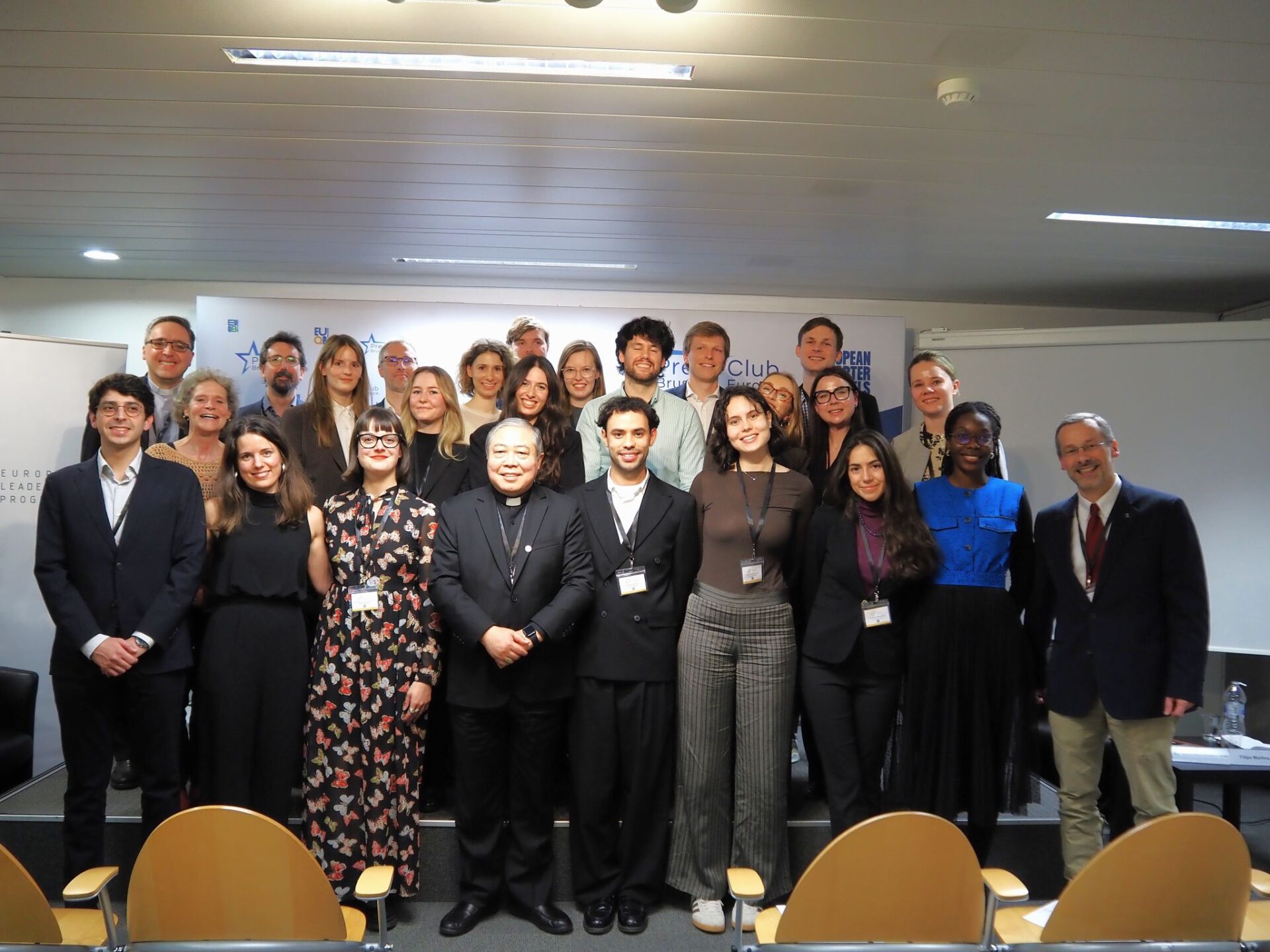
ELP Graduation February 2026
Dear Monseigneur, Dear ELP fellows, Dear friends,
Big party! Today marks the completion of your formation as European Leaders, that is to say, the formal conclusion of your enrolment in the European Leadership Programme (ELP) organized by JESC. As is almost self-evident, this formation is a lifelong endeavour and commitment. Less self-evident, although almost priceless, are the lifelong memories, lessons and friendships that you will hopefully carry with you. As director of UCSIA, the University Centre Saint-Ignatius Antwerp, it is always a pleasure to take part in the festivities on the occasion of your graduation. UCSIA is a university centre that invests in building bridges between academia, social organizations and civil society. We do so because we strongly believe in a holistic formation that connects wisdom, experience and action. As accomplished ELP fellows, you will immediately recognize the Jesuit signature and understand why UCSIA has actively supported the European Leadership Programme for many years.
Two years ago, UCSIA launched its UCSIA Solidarity Academy. It is a place, a physical place, viz. our renovated UCSIA building in the historic heart of Antwerp. But it is also a mental space. That is to say, it is a place where people from diverse backgrounds can meet, literally and figuratively, and find the space to develop and support concrete actions of solidarity based on innovative insights into solidarity. Conversely, meaningful practices of solidarity also offer opportunities to reflect on old and new forms of solidarity. Thinking and doing are not only intrinsically linked, they also reinforce each other through conscious interaction.
But what does ‘solidarity’ actually mean? Even more, what can it mean in a world characterized by emerging authoritarian leaders and weakening democracies, rising populism and polarization, the growing impact of climate change, increasing inequalities…? We are not only talking about multiple crises, but also about existential ones. In that regard, the ideas of two thinkers from the second half of the twentieth century might be very instructive. I am referring to the German-American thinker Hannah Arendt and the French philosopher Albert Camus, who both lived in times of rising totalitarian regimes and existential uncertainties.
Arendt masterfully analysed what it means to live in a world in crisis and how it relates to loneliness. For her, crisis is a moment of political disruption, in which existing structures no longer function. Loneliness in modern society, she argues, is not simply an individual feeling, but a structural phenomenon stemming from the disruption of social and political ties. Loneliness does not only mean social isolation but also a rupture with shared experience and truth. Those who are isolated have fewer opportunities to test reality through conversation and shared insights. This makes people susceptible to alternative realities, which totalitarian regimes create through propaganda.
However, a crisis is not only dangerous, according to Arendt, but also an opportunity. When people unite in solidarity and take action together, they can escape loneliness and resist oppression. For Arendt, thinking is a key element in resistance and solidarity. Thinking in itself is not action, but it is a prerequisite for responsible and solidarity-based action. When people reflect, they become aware of their own moral position and of the consequences of their actions.
It is worth recalling what Arendt wrote in her famous essay ‘The crisis in education’: ‘A crisis forces us back to the questions themselves and requires from us either new or old answers, but in any case direct judgements. A crisis becomes a disaster only when we respond to it with preformed judgements, that is, with prejudices. Such an attitude not only sharpens the crisis but makes us forfeit the experience of reality and the opportunity for reflection it provides.’
Albert Camus took a somewhat different perspective to analyse what it means to live in a world in crisis and loneliness. His approach is existential in nature. A crisis reveals the fundamental absurdity of existence: humanity yearns for order and meaning, but is confronted with a world that has no inherent meaning. This recognition leads to profound loneliness. Thinking, for Camus, is the realization of the absurdity of existence. In this situation, there are two possible responses: one can give up and retreat into nihilism or dogmatic thinking, or one can rise in moral rebellion against absurdity and choose solidarity and meaningful action, despite its meaninglessness.
In his famous essay L’homme revolté, Camus describes humanity as confronted with the absurd, a world without absolute meaning. Yet this does not mean we should surrender to despair: precisely in accepting the absurd lies the freedom to act. Solidarity is a choice, even in an uncertain and absurd world. Camus’s hero refuses to be passive. He shows solidarity as a conscious act, a commitment that does not rely on utopias or absolute certainties. In his work, Camus frequently refers to the myth of Prometheus, the figure who stole fire from the gods to advance humanity. For Camus, Prometheus symbolizes humanity, who, despite suffering and punishment, continues to fight for justice. Camus’s vision of hope is not naive hope, but a form of resilience and determination.
In our UCSIA Solidarity Academy, these values of thinking, taking responsibility, making judgements and embracing the freedom to act, all hold a central place. These are values that can never be taken for granted and must be cherished and put into practice every day. I am convinced that these were also the values at the heart of your ELP fellowship. I can only wish for you that they become – if they have not already done so – a second nature and that, as our future European leaders, you will pass them on to future generations as part of our precious tradition. We count on you to act accordingly. And in that sense, I conclude with the words of Arendt, since I could never express it more ingeniously:
‘The fact that man is capable of action means that the unexpected can be expected from him, that he is able to perform what is infinitely improbable.’
Erik De Bom
University Centre Saint-Ignatius Antwerp (UCSIA)