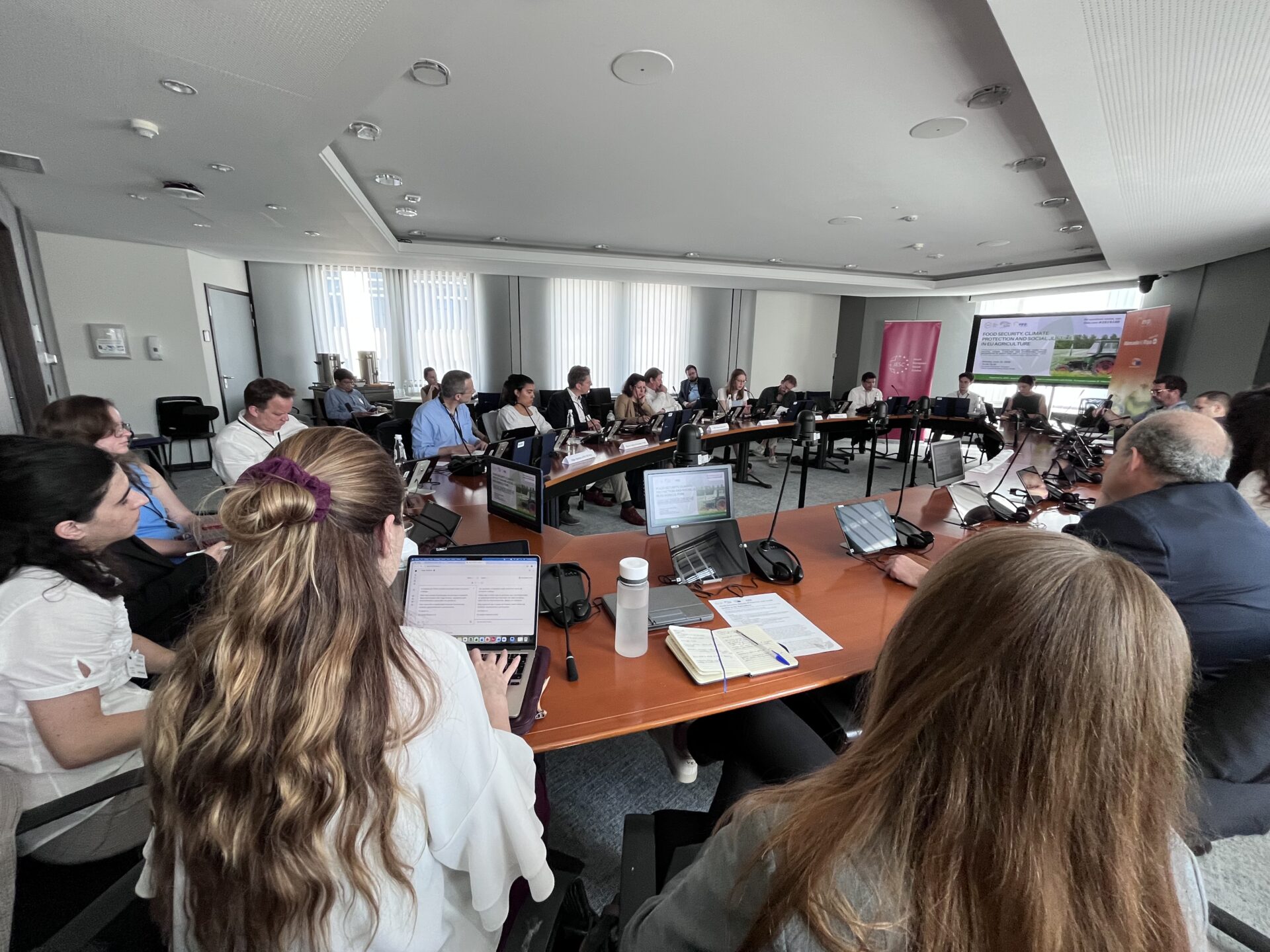
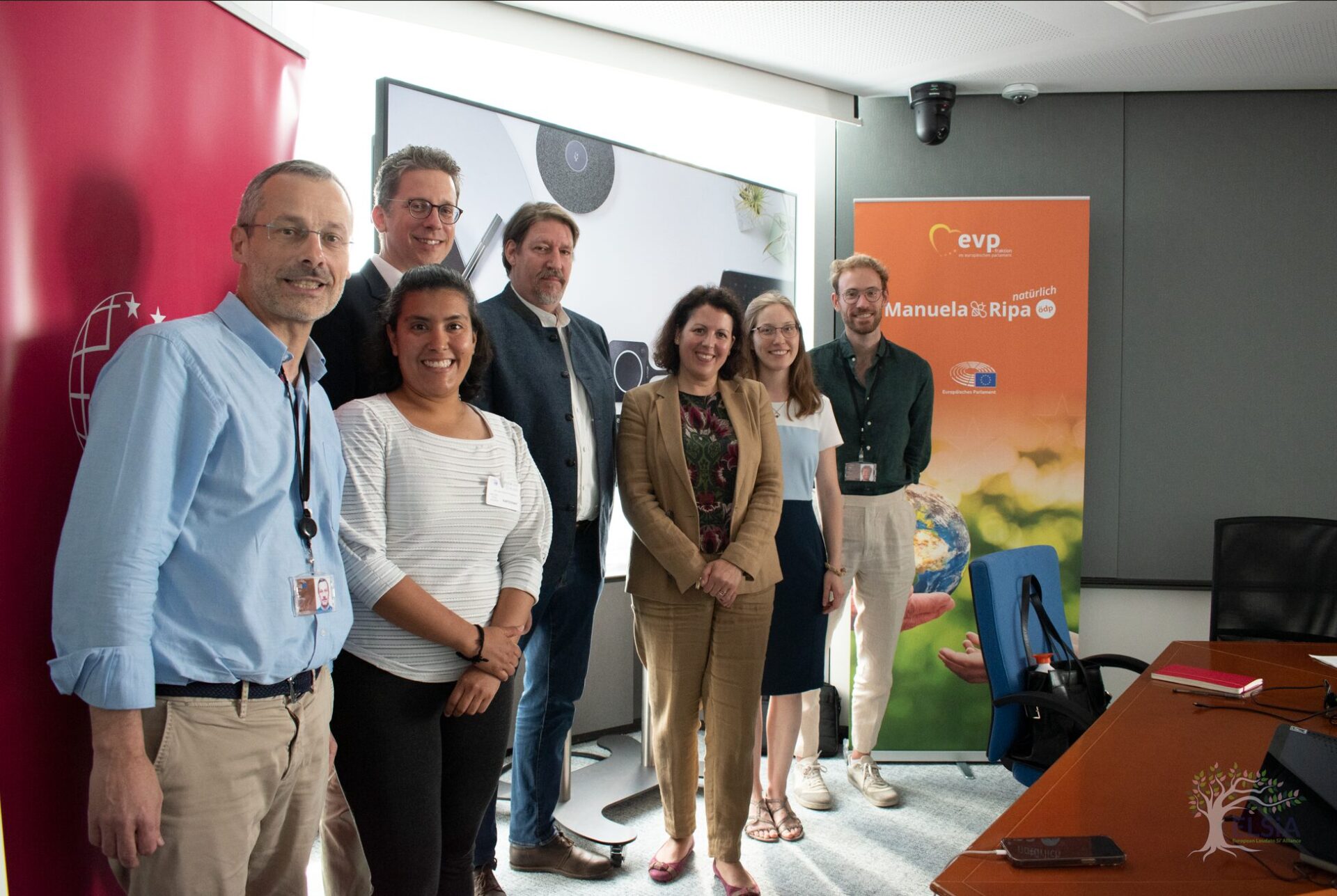
On 22 June 2026, the Jesuit European Social Centre (JESC), together with the European Laudato Si’ Alliance (ELSiA), hosted a dialogue at the European Parliament on the future of European agriculture and land use. The event, hosted by MEP Manuela Ripa (EPP, DE) brought together policymakers, environmental advocates, and representatives of the farming community to discuss how the European Union can reconcile food security, climate protection, biodiversity restoration, and viable rural livelihoods.
The discussion was centred on the recent study Food Security, Climate Protection and Biodiversity: Ethical Perspectives for Global Land Use, commissioned by the German Catholic Bishops’ Conference. Presenting the report’s findings, Dr Stefan Einsiedel highlighted the increasingly complex demands placed on agricultural land. Agriculture is expected to produce food, contribute to climate mitigation and adaptation, protect biodiversity, and sustain rural communities, all while operating within the ecological limits of a finite planet. The report argues that these objectives cannot be treated separately and calls for a systemic approach to land use that integrates environmental sustainability, social justice, and global responsibility.
A central theme of the panel discussion, with the presence of MEP Thomas Waitz (Greens/EPA, AT), MIJARC Europe’s Sophie Utner and EEB’s Théo Paquet and moderated by researcher Maria Cordero-Fernandez, was the ethical dimension of land use. Participants reflected on the fact that land is not merely an economic resource but also a common good with social, ecological, and intergenerational significance. The report emphasises that decisions about agricultural production, consumption patterns, trade, and land management have consequences far beyond Europe, affecting ecosystems, food security, and vulnerable populations worldwide. This requires policies that acknowledge planetary boundaries while ensuring a just distribution of benefits and burdens.
At the same time, speakers stressed that ambitious environmental objectives will only succeed if they are compatible with the economic realities faced by farmers. Representatives of both the farming and environmental communities recognised that farmers are often expected to deliver public goods such as biodiversity conservation, carbon sequestration, landscape management, and water protection, without always receiving adequate support or remuneration. The discussion therefore focused on how policy frameworks can better reward sustainable farming practices while ensuring that agricultural livelihoods remain economically viable.
The event demonstrated the value of dialogue between ethical reflection, environmental science, policymaking, and farming experience. The timing of the discussion is particularly significant. Negotiations on the next EU Multiannual Financial Framework (MFF) are now underway, and the future of the Common Agriculture Policy (CAP) remains one of the most important questions in those talks. Agriculture continues to account for roughly one-third of EU spending and remains one of the Union’s most visible policies. At a moment when competing priorities such as defence, competitiveness, and energy security are placing increasing pressure on public finances, the debate over the future CAP will play a decisive role in shaping how Europe balances food security, environmental sustainability, and social justice in the years ahead.
Telmo Olascoaga
JESC Ecology Officer
The full video of the session is available here