Source: European Commission 2026
Von der Leyen named climate change and AI as the defining tipping points. Where the threat comes from outside Europe, she proposed rewriting the rules. Where the pressure builds inside, she mostly extended the existing toolbox.
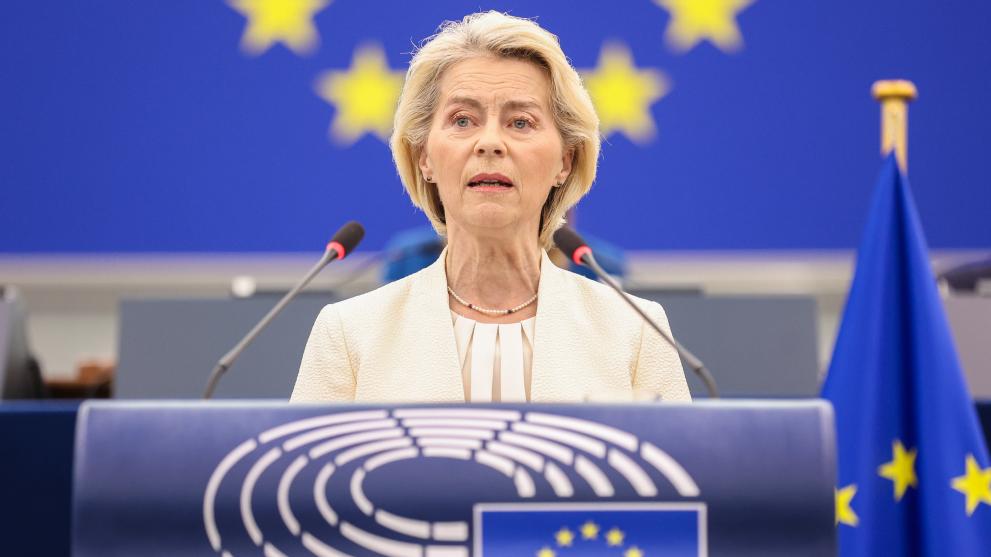
Ursula von der Leyen delivered her second State of the Union of this Commission’s term in Strasbourg on 16 September. She spoke after a summer of fires and heat, an energy shock from the closure of the Strait of Hormuz, and a trade deficit with China of €1 billion a day. The speech’s organising idea was independence, and within it she called climate change and AI “the tipping points of our time”.
A tipping point is a threshold past which change turns abrupt and hard to reverse. A response has to change in scale, not only in speed. By that test, the speech was uneven.
Where the speech did tip
On security, she conceded that the EU’s institutions and decision-making have not kept pace with hybrid attacks. She proposed an Emergency Security Protocol, a European counterpart to NATO’s Article 4, and a European Security Council. On AI, she said she would invite the frontier labs to discuss slowing the pace of development. On children online, the EU KIDS ACT would bar social media under 13 and make platforms prove they are safe. Whatever one thinks of each, they change how Europe works, not just how much it spends.
Climate and energy: managing consequences
The recognition of climate change was real. She cited 660,000 hectares burnt and reaffirmed the targets. The new measures include a resilience framework for 100 vulnerable territories, a Climate Insurance Alliance, a Heatwave Plan and a European firefighting fleet. But the shape is emergency response, insurance and cooling. Nature appears only as a victim. Forests, wetlands and soils, which buffer heat, drought and floods, go unmentioned, as do pollution and toxic chemicals.
Energy follows the same pattern. The goal of doubling the electricity share by 2040 gives a direction, but the problem is defined as imported fossil fuels, not fossil fuels themselves, and demand barely features. 9.2% of EU residents could not keep their homes adequately warm in 2024, and by 2025 the rate was more than twice as high in pre-1960 dwellings as in homes built since 2011. A transition that never reaches older, poorer housing will lose public support before it delivers.
Simplification: the bottleneck isn’t safeguards
The speech pairs faster permitting with a call on Member States to stop gold-plating. Nothing in it proposes weaker standards, and its own evidence points elsewhere: Europe installed over 80 gigawatts of renewables last year, yet six times that capacity awaits a grid connection. That is a bottleneck of infrastructure and administrative capacity, not of safeguards. The risk lies in the definition. If gold-plating comes to mean discouraging states from going beyond the EU minimum on health or nature, Europe would be levelling down just when it needs stronger protections.
The missing story
The social agenda was real, with a Housing Act, a Care Deal and a Quality Jobs Act. But the diagnosis is thin. Cost-of-living and housing worries are called legitimate, then said to be weaponised to divide Europeans. The chain runs from grievance to exploitation, not from policy failure to distrust. Democracy is likewise defended against disinformation and backsliding, but less renewed for citizens.
Beneath these gaps lies a larger omission. The speech gives Europeans a great deal to be protected from: a hostile world, hybrid attacks, extreme heat, machines that may outrun their makers. It gives them a long list of instruments. What it does not offer is a picture of the future that ordinary people can look forward to and see themselves in. It calls the Union at once the strongest it has ever been and the most precarious, and for most of its length it stays with the second half.
That matters because politics is not only administration. Managing threats, dependencies and budgets is necessary, but it does not tell people where things are going, and politics runs on that shared sense. Where mainstream politics offers vigilance instead of hope, others fill the vacuum. Anti-European movements offer belonging, grievance and simple answers, and ask in return for the openness, rule of law and solidarity that Europe stands for. The speech names these forces but treats the turn towards them mainly as manipulation, less as a verdict on what the centre has failed to provide. It gestures at the problem in its closing minutes, promising to win back hearts and a Congress of Europe next year. That is a cultural project deferred to next year, not the purpose every proposal above it should serve.
The stakes are structural. The European social contract rests on consent, and consent rests on hope. A union can be guarded with security protocols and conditions on its funds, but it cannot be held together that way if enough citizens conclude the bargain no longer works for them or their children.
Tipping points can run in either direction. Whether Europe’s politics tip towards or away from the Union will depend less on what it guards against than on what it gives people to believe in.
Telmo Olascoaga
JESC Ecology Officer